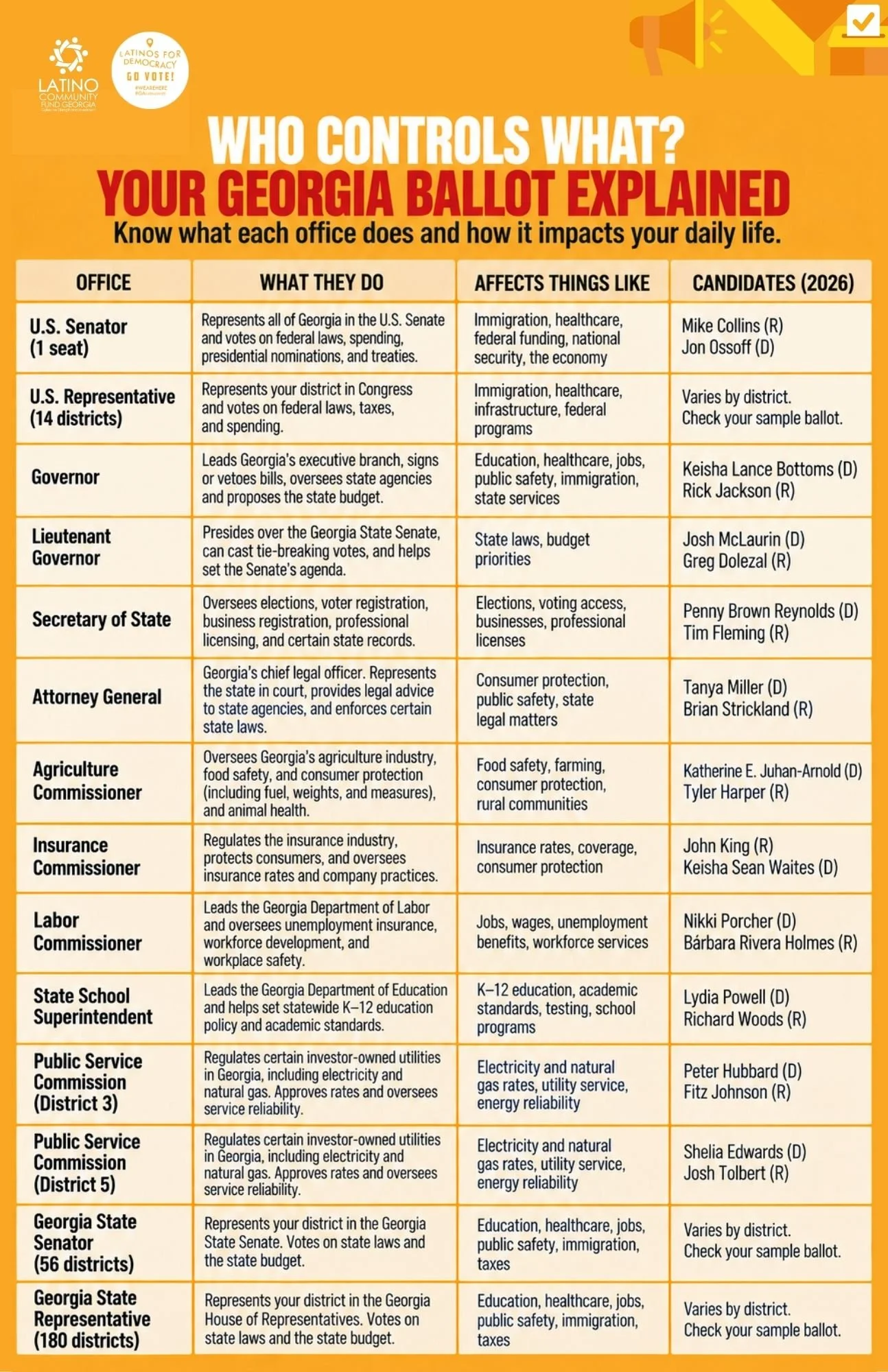
Who Controls What?
Your Georgia Ballot Explained
The people who will create and pass laws, the people who will put money on the issues that matter to you, the people who will determine who gets services and how, are all on the ballot this year. If you care about your children in the classroom, the local clinic and hospital services, and how much the minimum wage is, then you have reasons to vote in this election.
See below how each position on the ballot is connected to things that matter to you: Education, healthcare, wages, community safety, and immigration, and who controls each one.
Education

The State School Superintendent sets Georgia's K-12 standards, testing rules, educational programs, and guides local school districts and their priorities.
The State Legislature (House Representatives and Senators) decides how much state money goes to schools each year through the state budget.
Local school boards, elected separately, make day-to-day decisions for your child's actual school, from what books your child has to read and disciplinary policies to FREE school meals programs.
The Governor appoints the Board of Regents and other leaders to determine who gets to go to public universities, who pays in-state tuition, who is banned, and who gets to practice medicine and other licensed professions.
Healthcare
& Food

The Insurance Commissioner regulates the insurance companies operating in Georgia, reviews certain rates and insurance plans, licenses insurance agents, and investigates fraud and consumer complaints.
The Governor and State Legislature shape the state budget, which determines how much state money goes to health programs and services, local clinics, and programs for low-income families, including Medicaid and emergency services.
State Legislators can pass laws and approve funding to expand Medicaid eligibility and other state health programs. Some Medicaid changes also require action by the Governor and approval from the federal government.
The Commissioner of Agriculture regulates areas including pesticides, food safety, and animal health and safety.
No Georgia office makes your personal medical decisions. Federal programs stay federal, and treatment choices stay between you and your doctor.
Wages, Entrepreneurship & Jobs

The Labor Commissioner oversees unemployment insurance, job-placement services, and workforce development, and publishes Georgia's labor market data. They determine the support workers receive when they are the subject of complaints.
The State Legislature (Representatives and Senators) writes Georgia's wage and workplace laws. Decides whether to raise or not the current official state minimum wage, which has been $5.15 since 2001. However, with limited exceptions, the federal minimum wage of $7.25 applies in Georgia. The legislature also determines who qualifies to apply for business licenses; for example, an undocumented entrepreneur may not be able to get certain licenses in Georgia, even though their business may be formally incorporated and paying taxes.
The Governor appoints commissioners who determine who gets to do certain jobs and get licenses or specific permits.
Community Safety
The Attorney General is Georgia's chief legal officer: represents the state in court, advises state agencies, and handles certain public-corruption cases and other state legal matters.
The Governor oversees state agencies that enforce state law and can direct state agencies to cooperate with federal law enforcement, including through programs like 287(g).
County Sheriffs and District Attorneys are elected for each county. Sheriffs oversee law enforcement and county jails, while District Attorneys prosecute criminal cases. Local law-enforcement agencies may also cooperate with ICE through programs like 287(g), subject to state and federal law.
The Attorney General does not give you personal legal advice and does not handle most everyday local crimes. That's local law enforcement's job: like Sheriffs and Police Chiefs, and local prosecutors, like District Attorneys.
US Senators do have a vote on committees that may be related to immigration, like Homeland Security.
Immigration
No Georgia state office controls paths to legal status, citizenship, or protection of immigrants. However, Georgia's elected and appointed officials can make decisions that affect immigrants in the state:
Legislators (House and Senate) create state laws that can require cooperation with ICE or protections. They also create barriers or expand access to programs like food stamps, healthcare access, etc.
The Governor appoints people to the Board of Regents, which sets policies that determine whether some immigrant students can attend certain Georgia public universities and whether they can qualify for in-state tuition.
Sheriffs and local law enforcement agencies make decisions about some forms of cooperation with federal immigration authorities, within the requirements of state and federal law.
State and local officials can make decisions that affect immigrants' daily lives through policing, education, and access to state and local services. But federal immigration law is written in Washington, D.C. This year, two types of positions on your ballot vote on federal immigration laws: U.S. Senator and U.S. Representative.
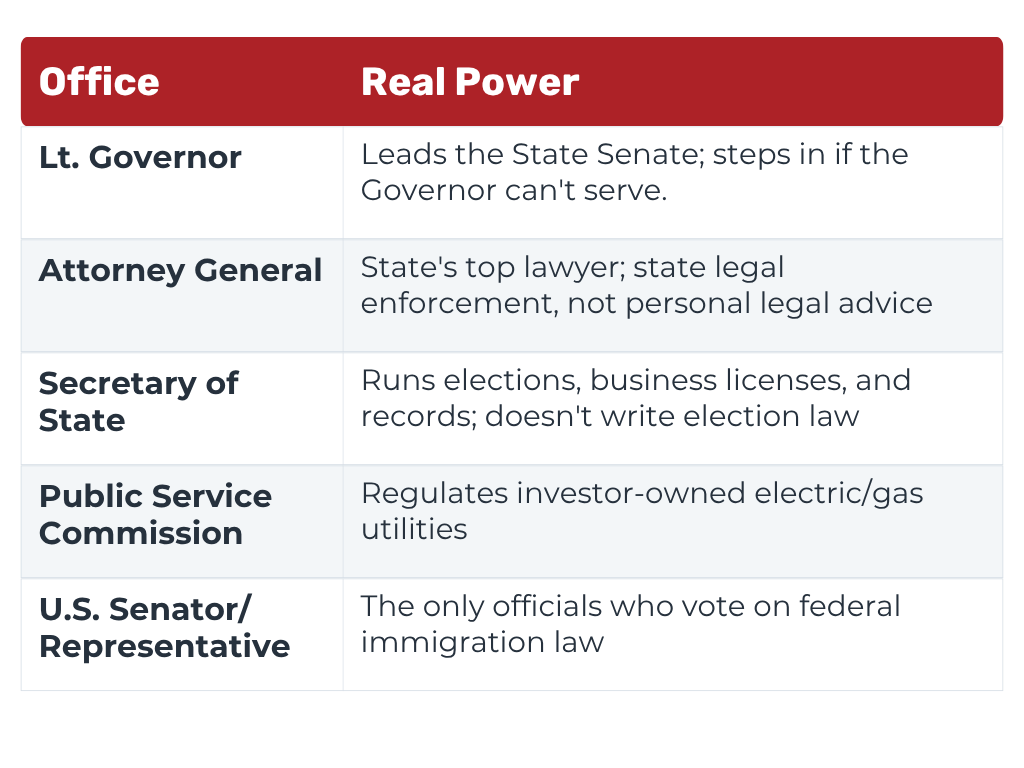
Other Offices
Bottom line: No single vote fixes everything. Vote for ALL the positions; they all matter.
GENERAL ELECTIONS 2026
August 17: First Day to Request an Absentee Ballot
October 5: Last Day to Register to Vote
October 13: First Day of Early Voting
October 17 and 24: Statewide Saturday Voting
October 23: Last Day to Request an Absentee Ballot
October 30: Last Day of Early Voting
November 3: Election Day
Who Controls What Chart
Want a quick overview to take with you? Download our "Who Controls What?" cheat sheet for a simple breakdown of every office on your ballot. From local school boards to federal senators, you can stay informed and ready to vote!